Summertime is almost upon us, which means football season isn’t far away. And just when you thought college football couldn’t move any faster, the landscape is shifting again. The massive tectonic movements of the Power Four have finally stabilized, but the rest of the Football Bowl Subdivision (FBS) is seeing a massive wave of activity for the 2026/2027 season. Between the rebuilt Pac-12, new Group of Five additions, and critical game-play rule updates approved by the NCAA, the upcoming season will look vastly different on and off the field.
Here Is Exactly What Is Changing for the 2026 College Football Season
The New Conference Landscape: Rebuilding the Pac-12 and Mid-Major Drama
While the ACC, Big Ten, Big 12, and SEC are holding steady with their memberships this year, the rest of the FBS is in a total state of realignment. The big headlines are the Pac-12’s rebirth and major additions to Conference USA and the MAC.
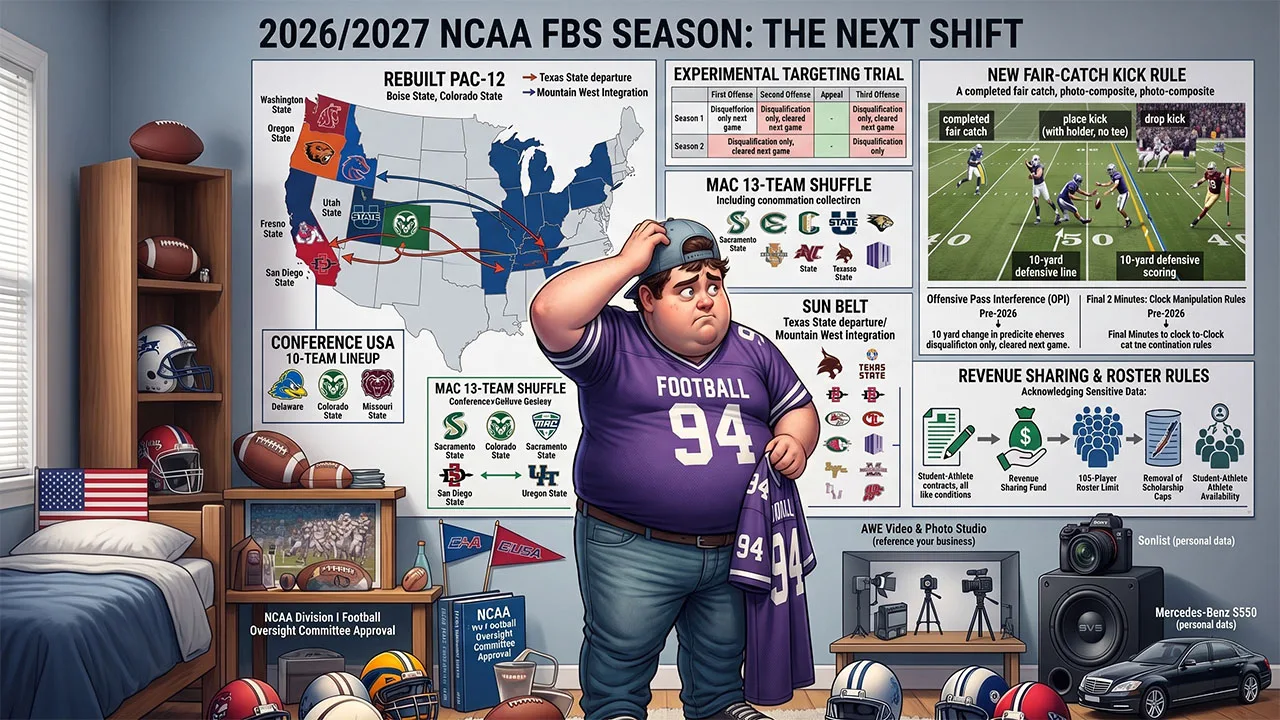
The Rebuilt Pac-12
After dropping down to just two members, the Pac-12 has successfully raided the Mountain West to rebuild its ranks. Five programs officially make the jump to the Pac-12 for the 2026 season:
- Boise State
- Colorado State
- Fresno State
- San Diego State
- Utah State
They join Oregon State and Washington State, bringing the conference to seven football-playing members, with ongoing plans to meet the NCAA minimum requirement of eight.
Conference USA’s New Look
Conference USA continues to reinvent itself by pulling top talent from the FCS ranks and moving into new regions. For 2026, C-USA welcomes two brand-new transition members to the FBS level:
- Delaware (moving up from the CAA)
- Missouri State (moving up from the MVFC)
These additions bring Conference USA to a stable 10-team football lineup.
The MAC Reaches 13
The Mid-American Conference is expanding its footprint into the FCS ranks as well. Sacramento State officially joins the MAC as a football-only member for the 2026 season, bringing the conference’s total football membership to 13 teams.
Sun Belt Shuffle
Texas State is departing the Sun Belt to join the newly aligned Mountain West. To offset the loss, the Sun Belt adds Louisiana Tech from Conference USA, maintaining a strong 14-team roster.
The 2026 Rule Changes: Targeting Overhauls and NFL Alignment
The NCAA Division I Football Oversight Committee officially approved a slate of rules for the 2026 season designed to modernize the game, clean up late-game administrative issues, and fix a few penalties that were historically too harsh.
1. Experimental Targeting Penalty Structure
In a major victory for roster consistency, the NCAA is executing a one-year trial to eliminate the hated second-half carryover rule for a player’s first targeting offense.
- First Offense: The player is disqualified for the remainder of the current game but is fully cleared to play in the next game, regardless of which half the foul occurred in.
- Second Offense: If a player is flagged for targeting a second time in the same season, they will be disqualified for the current game and suspended for the first half of the next game. Conferences can appeal a second offense to the national coordinator.
- Third Offense: A third targeting call in one season triggers an automatic full-game suspension for the next game.
2. The Return of the Fair Catch Kick
Bringing a rare NFL and high school rule to the college game, teams can now attempt a “fair catch kick.” Following a completed or awarded fair catch, a team can choose to attempt a free field goal via a place kick (with a holder, no tee) or a drop kick from the spot of the catch. A successful kick awards 3 points, and the defense must line up at least 10 yards away.
3. Softening Offensive Pass Interference
The committee decided that a 15-yard penalty for offensive pass interference (OPI) was simply too punishing. Starting in 2026, OPI has been reduced to a 10-yard penalty, keeping it impactful but preventing it from completely killing offensive drives.
4. Freezing the Play Clock in the Final Two Minutes
To stop teams from manipulating the clock or losing valuable seconds during video reviews late in halves, the play clock rules have changed. After the Two-Minute Timeout in the 2nd and 4th quarters, if a replay official stops the game for a review, the play clock will be frozen at its current position. If the clock shows less than 10 seconds when frozen, it resets to 10 seconds before the referee signals the ball ready for play.
5. Unsportsmanlike Conduct and Formation Clarifications
- Celebration Focus: Officials are instructed to tighten the screws on taunting, actions that delay game administration, or celebrations deemed genuinely demeaning to the opponent.
- Punt Formations: To clear up defensive confusion on scrimmage kicks, rules now specify that when jersey number exceptions are used, the snapper and the two adjacent linemen inside the tackle box are automatically ineligible receivers by position.
Final Thoughts: The Real Changes the NCAA Must Implement Before the Bottom Falls Out
The 2026/2027 season proves once again that college football remains in a constant state of evolution. The Group of Five and a reconstructed Pac-12 will provide entirely new conference title races, while the rules adjustments—particularly regarding targeting and late-game replay clocks—will directly alter how close games are coached and played in September.
Changes are one thing, but fan loyalty to the game should be of paramount concern for the NCAA, because it’s getting harder and harder for them to put butts in those stadium seats.
The financial barrier to entry has officially skyrocketed. Looking at recent data, regular-season ticket invoices at major programs are climbing relentlessly. For instance, powerhouse programs like Georgia and Texas now command average tickets eclipsing $270 just to walk through the turnstiles, with marquee SEC matchups easily forcing fans to drop $380 to over $700 for a single seat. Even historically, mid-tier ticket prices have seen massive single-year surges, with schools like Tennessee tacking on mandatory 10% “talent fees” to season tickets, alongside stadium construction costs, pushing their average home-game price past $170. When a standard Saturday afternoon for a family of four clears the $1,000 threshold after factoring in $40 parking and stadium concessions, the average fan is priced entirely out of the experience.
Unsurprisingly, stadium attendance is reflecting this strain. While athletic departments frequently report inflated, “announced” attendance numbers, internal university audit data and turnstile scans reveal a far bleaker reality. Across the FBS, actual scanned attendance often hovers at just 71% of what schools publicly report, as thousands of ticket holders simply opt to stay home. In mid-major conferences like the MAC, actual butts in seats have plummeted to as low as 45% of announced figures. With pristine, 4K big-screen broadcasts, multi-angle instant replays, and zero traffic to fight, the couch is dominating the stadium concourse.
Compounding the cost crisis is a generic, uniform style of play that is actively draining the sport’s historic charm. As the sport increasingly mirrors the professional ranks structurally, it is also mirroring them tactically. The distinctive regional identities that once defined college football—the brutal precision of the triple option, the radical variations of the true air raid, distinct conference defensive philosophies, or just the different-style uniforms the teams wore—have largely been ironed out. Instead, viewers are left with a sanitized, highly commercialized product where nearly every team runs a variation of the same homogenized spread offense. That’s not an interestingly fun thing to watch like it once was. If the leadership of this sport continues to treat fans like a bottomless ATM to fund a frantic arms race, they will find out the hard way that once those traditions are broken and the stadium seats go cold, you can’t just buy them back.